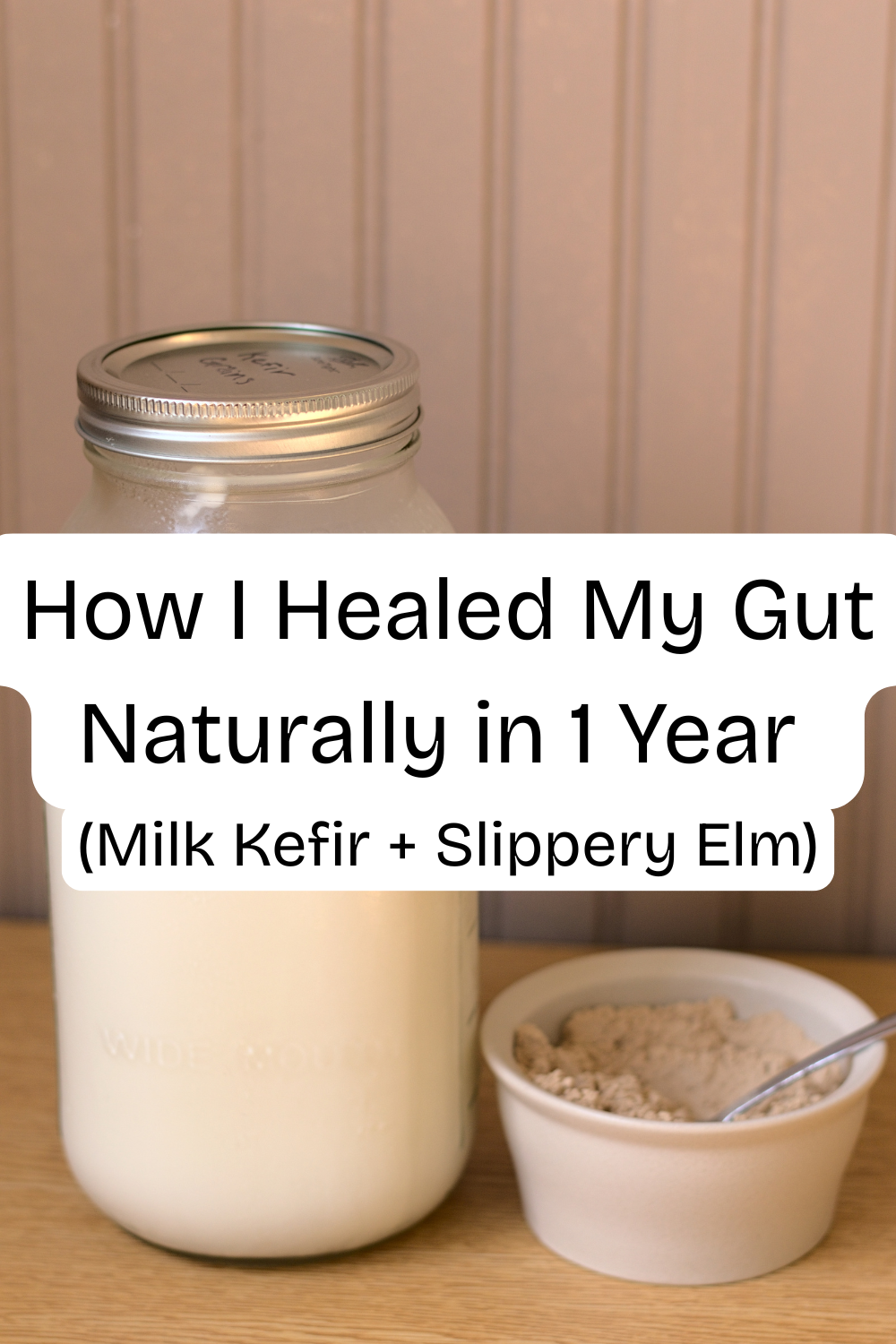
In just one year my gut was healed after adding only two ingredients to my diet.
No more running to the bathroom immediately after having a cup of coffee, I can enjoy a road trip, or shopping without being worried about feeling the need to go.
This combination changed my life: Homemade Milk Kefir and Slippery Elm Bark
Milk Kefir is the most powerful probiotic drink that you can have. It can contain 60+ different strains and over 100 billion colonies per cup. That’s more than any other probiotic drink, or food on the market, or any that you can make on your own.
It specifically has to be homemade Milk Kefir because the store bought is so heavily regulated that there isn’t nearly enough probiotics in it to actually heal the gut. However, it is so easy to make, all you need are some Milk Kefir grains (I ordered mine off of Yeemos cultures website) and some whole milk. I have a post called How to Make Milk Kefir if you are interested.
Slippery elm bark is one of the best herbs for healing the digestive tract. Slippery elm is a powerful demulcent, which means its key property is its mucilage content. The mucilage will form a protective layer in your digestive tract. Slippery Elm Bark is the ingredient you need to actually heal the gut lining. Here is a link for the one I use: https://amzn.to/41ygnJe
Milk Kefir rebuilds the gut microbiome. Slippery Elm repairs and protects the gut lining. Together, they support complete gut healing from the inside out.
I used these ingredients typically in a daily smoothie, but if I had opted for something else, I would add the slippery elm bark to my coffee. With milk kefir, I would sometimes make other things with it, like kefir cheese or a kefir Popsicle.
Important: If you decide to start with these ingredients, start small. Milk kefir is a probiotic, so you need to start off with a teaspoon if you haven’t introduced probiotics to your gut. At max, start with 1/4 cup, but I would still suggest starting with a teaspoon and working your way up.
Slippery Elm Bark becomes gel-like when introduced to liquid. You can use this ingredient in drinks or even add it to some honey or peanut butter. You only need a tiny amount, 1/4 tsp will do just fine.
A Quick Note If You Have SIBO
If you’ve been diagnosed with SIBO (Small Intestinal Bacterial Overgrowth), you may need to go extra slow with milk kefir. I also suggest consulting your physician before introducing kefir.
Since kefir is very high in probiotics, some people with SIBO can experience bloating or discomfort when introducing it.
If that’s you:
- Start with a teaspoon amount, or even half a teaspoon
- Pay attention to how your body responds
- Or consider waiting until your symptoms are more stable
Slippery elm bark, on the other hand, is typically much gentler and may still be helpful for soothing the gut.
Final Thoughts: A Simple, Natural Approach to Gut Healing
There’s no one-size-fits-all solution for gut health, but this combination is:
- Natural
- Affordable
- Easy to implement
- Backed by emerging research on probiotics and herbal gut support
If you’re struggling with digestive issues, this might be worth trying. Just remember to go slow and stay consistent. Results won’t be overnight, just like the gut didn’t decline overnight. However, results can be seen slowly over a few weeks. In just a few months, you’ll notice your body can handle a cup of coffee. Within a year, you’ll notice most symptoms of a bad gut have all but vanished.
Let me know in the comments if you try this or have tried this. If you have been successful with healing the gut in an alternate way, please share!
This post may contain affiliate links, including Amazon links. This means I may earn a small commission if you purchase through these links at no extra cost to you. I only share products I personally use and love.
Bui G, Marco ML. Impact of Fermented Dairy on Gastrointestinal Health and Associated Biomarkers. Nutr Rev. 2025 Jul 24:nuaf114. doi: 10.1093/nutrit/nuaf114. Epub ahead of print. PMID: 40706019.
Ried K, Travica N, Dorairaj R, Sali A. Herbal formula improves upper and lower gastrointestinal symptoms and gut health in Australian adults with digestive disorders. Nutr Res. 2020 Apr;76:37-51. doi: 10.1016/j.nutres.2020.02.008. Epub 2020 Feb 8. PMID: 32151878.

Leave a Reply